Description
Richard Kaczynski (Author)
Park Street Press, 2025. Paperback. 352 pages. Brand New.
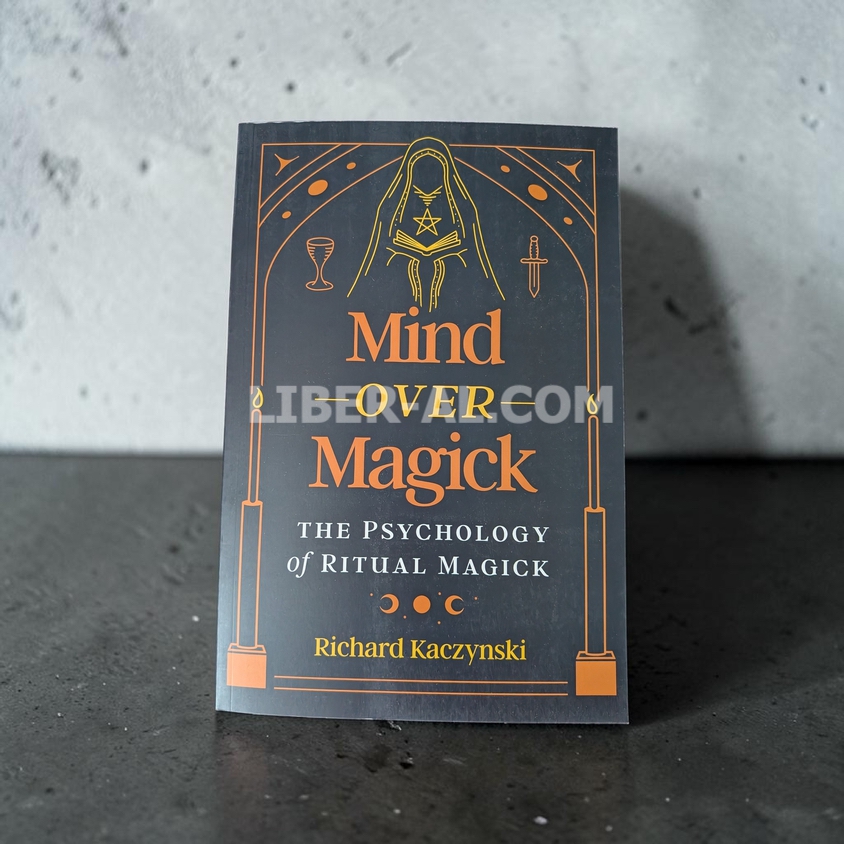
In Mind Over Magick: The Psychology of Ritual Magick (October 2025), Richard Kaczynski explores the many fascinating connections between the practices of ritual magicians of all traditions with the findings of peer-reviewed research in psychology, neuroscience, and real-time brain imaging.
From the publisher:
Kaczynski examines mystical states and magical practice. He shows how being “in the zone,” as described by athletes, is consistent with the ritualist’s state of mind when working magic. With empirically proven tools, he suggests ways to strengthen your practice of magic, meditation, and yoga.
- Draws on peer-reviewed research in psychology and cognitive neuroscience, such as real-time brain imaging, to examine the effects of mystical states and magical practice
- Shows how being “in the zone,” as described by athletes and performers, is consistent with the ritualist’s state of mind when working magic
- Suggests rituals and routines to strengthen one’s practice of magic, witchcraft, meditation, and yoga with empirically proven tools
By looking through the lens of psychology, cognitive neuroscience, and real-time brain imaging, Mind over Magick shows how and why ritual magical practice can produce profound experiences with tangible benefits.
The author draws on a wealth of peer-reviewed research to shed new light on magic. He uses the infamous Stanford Prison Experiment, in which subjects role-played as prisoners and guards, to reveal the power of magical vestments and personas and the effects they have on ritual practitioners. The author shows how being “in the zone,” as described by athletes and performers, is consistent with the ritualist’s state of mind when working magic. He also reveals what neurological processes are involved when one encounters and works with spirits. Rituals are suggested to strengthen one’s practice of magic, witchcraft, meditation, and yoga with empirically proven tools for optimal results. Readers can apply the scientific method to critically evaluate their own spiritual praxis and determine what works best for them. Solitary practitioners and group participants alike will learn what happens, both on a psychological and neurological level, when they enter sacred spaces and use ritual implements as well as enter deep meditative states. The author also details the importance of initiation as a rite of passage and transformative method of instruction.
With this book, readers can approach the art of practicing magic as a science in order to hone a more effective and empirically grounded practice.
Praise for Mind Over Magick:
“Destiny dwells in these pages. Any magickal practitioner, seeker, or student of life who reads Richard Kaczynski’s Mind Over Magick will discover new personal paths and insights from one of the most erudite, unpredictable, learned, and profound intellects writing today in the magickal space. From Richard’s chilling, unforgettable opening pages to his finely reasoned psycho-metaphysical insights and breakthroughs—and practices to accompany them—Mind Over Magick harbors a destiny of its own: occult classic.” — Mitch Horowitz PEN Award-winning historian and author of Practical Magick
“Mind Over Magick presents a compelling exploration of ritual magick through the lens of psychology and cognitive neuroscience, revealing how structured symbolic practices produce significant shifts in the magician’s perceptions, emotions, and behavior. Drawing on peer-reviewed research, Richard Kaczynski offers a clear framework for understanding the psychological foundations of transformative spiritual and magickal experience.” — Dean Radin PhD, Chief Scientist, Institute of Noetic Sciences and author, The Science of Magic, and other books
“Richard Kaczynski is a trained social psychologist and statistician who knows there is “something” there and present in magick but who also knows the professional practice of science inside and out. Here is a most striking science of magick that is also an implicit theory of popular culture and the ever-present paranormal. We are always and everywhere so attracted, it turns out, not because of bad beliefs or misperceptions but because of who and what we really are—magickal and material at the same time. “ — Jeffrey J. Kripal, author of How to Think Impossibly: About Souls, UFOs, Time, Belief, and Everything Else
“Finally—the book I’ve been hoping Dr. Kaczynski would write for the 20+ years since I first met him. An absolute must-read for anyone interested in the interface of psychology and occultism.” — David Shoemaker, Psy.D., psychologist, teacher, and author of Living Thelema and other titles”
About the Author: